
Basket Strainer
Cooling Tower Filtration Systems
เม.ย.
Cooling Tower Filtration Systems
Cooling Tower Filtration Systems : Cooling tower systems are widely used in industrial facilities, HVAC systems, and power generation plants to remove heat from circulating water through evaporative cooling. These systems operate with large volumes of recirculating water that are continuously exposed to environmental contaminants such as airborne debris, suspended solids, biological matter, and corrosion products.
Because cooling towers are open or semi-open systems, contaminants inevitably enter the water circuit. Without adequate filtration, these solids accumulate within piping networks, heat exchangers, pumps, valves, and spray nozzles. Over time, this accumulation increases hydraulic resistance, disrupts heat transfer efficiency, and accelerates equipment wear.
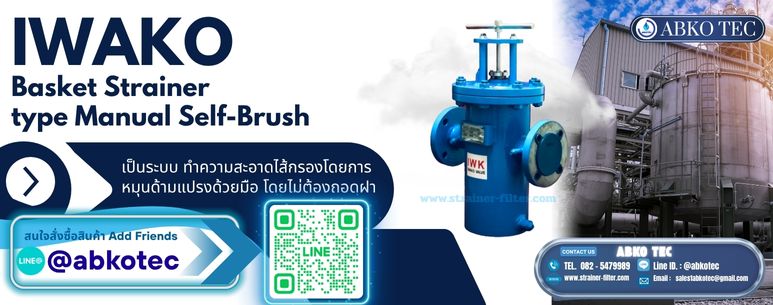
A basket strainer is a mechanical filtration device installed within piping systems to capture suspended solids before they reach sensitive downstream equipment. In cooling tower circulation loops, basket strainers serve as primary protection devices that intercept debris and particulate matter.
Role of Filtration in Cooling Tower Circulating Water Systems
Cooling tower water circuits continuously circulate large volumes of water through pumps, distribution headers, heat exchangers, and process equipment. During this circulation, suspended contaminants are transported throughout the system.
Typical sources of contamination include:
- Atmospheric dust and sand
- Leaves, insects, and organic debris
- Corrosion products from piping systems
- Biological growth and biofilm fragments
- Scale particles from mineral precipitation
- Construction debris or system startup residues
Without proper filtration, these contaminants accumulate within piping and equipment. Over time, this leads to operational issues such as restricted flow passages, blocked spray nozzles, and fouled heat transfer surfaces.
Mechanical filtration using basket strainers provides a first-line defense against these contaminants by physically removing suspended solids from the circulating water stream.
What Is a Basket Strainer in Cooling Tower Applications?
A basket strainer is a pipeline filtration device designed to remove coarse solids from flowing fluids. It typically consists of a pressure-rated housing containing a removable cylindrical or basket-shaped filter element.
The filtration element is usually fabricated from perforated metal sheet, wire mesh, or a combination of both. Fluid enters the strainer housing, passes through the filter basket, and exits through the outlet connection while solid contaminants are retained inside the basket.
In cooling tower systems, basket strainers are typically installed in locations such as:
- Pump suction lines
- Heat exchanger inlet lines
- Process equipment protection points
- Main circulating water headers
- Side-stream filtration loops
The defining characteristic of basket strainers is their large filtration surface area, which enables them to handle high flow rates while maintaining relatively low pressure drop.
Compared with other strainer types such as Y-strainers, basket strainers are better suited for large flow systems commonly found in cooling tower circulation loops.
Functions of Basket Strainers in Cooling Towers
Basket strainers perform several critical engineering functions within cooling tower systems.
Protection of Pumps
Cooling tower pumps are vulnerable to damage from suspended solids. Hard particles such as sand or corrosion debris can erode pump impellers and damage mechanical seals. By capturing these particles upstream, basket strainers reduce mechanical wear and extend pump service life.
Protection of Heat Exchangers
Heat exchangers rely on clean water flow across heat transfer surfaces. Even small particles can accumulate within narrow passages, causing fouling and reduced heat transfer performance. Basket strainers intercept suspended solids before they reach heat exchangers, thereby preserving thermal efficiency.
Prevention of Spray Nozzle Blockage
Cooling towers use spray nozzles to distribute water evenly over fill media. Small debris can block these nozzles, resulting in uneven water distribution and reduced cooling performance. Installing basket strainers upstream helps prevent nozzle obstruction.
Reduction of System Fouling
Suspended solids promote the formation of sludge deposits in low-velocity areas of piping and equipment. By removing these solids early in the flow path, basket strainers reduce system fouling.
Improvement of Operational Stability
Stable hydraulic conditions are essential for consistent cooling tower performance. Removing debris from the water stream helps maintain predictable flow characteristics throughout the system.
Design Considerations for Basket Strainers in Cooling Tower Systems
-Filtration Area
-Filter Screen Mesh and Perforation Size
-Material Compatibility
-Pressure Rating
-Access for Maintenance
-Flow Rate
-Acceptable Pressure Drop
FAQ: Basket Strainers in Cooling Tower Systems
Why are basket strainers commonly used in cooling tower systems?
Cooling towers are open systems exposed to environmental contaminants. Basket strainers remove suspended debris from circulating water, protecting pumps, heat exchangers, and spray nozzles from clogging and mechanical damage.
Where should basket strainers be installed in a cooling tower system?
Typical installation locations include pump suction lines, heat exchanger inlets, and main circulating water headers where equipment protection is required.
How often should cooling tower basket strainers be cleaned?
Cleaning frequency depends on debris loading and filtration mesh size. Monitoring differential pressure across the strainer provides an effective method for determining when maintenance is required.
What mesh size is typically used for cooling tower strainers?
Mesh selection depends on the size of particles that must be removed. Coarse perforated baskets are often used for primary filtration, while finer mesh may be used when protection of sensitive equipment is required.
Can basket strainers replace full filtration systems?
Basket strainers are designed for coarse debris removal. They are typically used as primary protection devices and may be combined with side-stream filtration systems for finer particulate control.
Ready Summary
Cooling tower systems continuously circulate large volumes of water that are exposed to environmental contaminants such as dust, organic debris, corrosion particles, and biological matter.
A basket strainer is a pipeline filtration device that removes suspended solids from the circulating water stream. It consists of a pressure-rated housing containing a removable filtration basket made from perforated metal or wire mesh.
In cooling tower applications, basket strainers serve several engineering functions: protecting pumps from abrasive particles, preventing blockage of spray nozzles, reducing fouling in heat exchangers, and maintaining stable hydraulic performance in the piping network.
Proper engineering design requires consideration of filtration area, mesh size, material compatibility, pressure rating, and maintenance accessibility. Correct sizing based on system flow rate and allowable pressure drop is essential to ensure reliable operation.
Routine inspection and cleaning are necessary to prevent excessive pressure differential across the basket and to maintain effective filtration.
For these reasons, basket strainers are widely considered an essential mechanical filtration component in cooling tower circulation systems.
For technical information regarding industrial basket strainers for cooling tower filtration systems, engineering teams and technical buyers may contact:
ABKOTEC
Tel: +66 82 547 9989
Email: sales1abkotec@gmail.com
Line ID: @abkotec
Engineering resources and product information:
www.strainer-filter.com
www.abkotec.com
ABKOTEC provides technical assistance regarding strainer selection, filtration design considerations, and application guidance for industrial piping systems.
