
Temporary Filter
How do screen filters work?
ม.ค.
How do screen filters work?
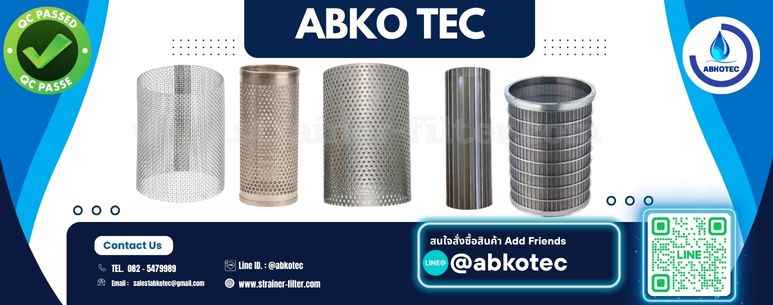
How do screen filters work? : As a mechanical engineer at IWAKO, I design stainless steel screen mesh filters as precise, rigid barriers that separate unwanted solids from liquids by pure mechanical sieving. A woven stainless lattice with controlled apertures is formed into a cylindrical, conical, or basket element and seated inside a strainer body so that all flow is forced through the mesh with no bypass paths. The flow approaches the upstream face, the wires create a grid of openings, and any particle larger than the opening is intercepted at the surface while smaller species pass through with the carrier fluid. Depending on the housing, the flow can move from outside to inside or from inside to outside; in both cases the geometry distributes load across the mesh and the supporting framework.
Although the dominant mechanism is straightforward sieving, several complementary effects improve capture. Particles that are only slightly smaller than the apertures are slowed and diverted by the boundary layer that forms around each wire, which promotes direct interception. Heavier particles can deviate from streamlines and impact the wires under higher local velocities, which aids removal. As more solids accumulate, they bridge the openings and create a thin, porous cake on the surface. That cake becomes a secondary filter medium that can trap even finer material than the original aperture would allow, raising clarity at the cost of additional resistance to flow. This self-forming precoat is why screen filters often become more efficient during a run until cleaning is performed.
The element itself is engineered to maintain shape, stability, and repeatable cut-off under pressure. We select corrosion-resistant stainless alloys and weave patterns that balance open area and strength, then laminate the mesh to a perforated core or a wedge-wire cage to resist deformation. Joints are welded to prevent seam creep, and the assembly is sealed with gaskets or o-rings against machined seats so that the only path available to the fluid is through the screen. In basket and cone forms used in strainers, generous internal volume is provided upstream of the mesh to settle heavy debris and to spread the flow evenly across the surface.
Hydraulically, a clean screen presents low resistance because the open area is high relative to the wetted path length around the wires. As solids accumulate, the pressure drop rises progressively. The rate of rise depends on fluid viscosity, particle shape, and the distribution of sizes in the stream, as well as the chosen weave and wire diameter. When the indicated differential reaches an operational limit, the filter is regenerated. For manual strainers, the basket or tube is lifted, the cake is rinsed away, and the surface is restored by gentle brushing, backflushing, ultrasonic agitation, or a suitable chemical wash that respects the metallurgy. For continuous duty, duplex or automatic designs keep flow online while the fouled element is isolated and cleaned. Self-cleaning versions use internal scrapers, suction nozzles, or periodic reversal of flow to dislodge the cake without opening the vessel.
Because the screen is a true surface medium, its cut-off is defined by the physical aperture rather than by a depth gradient. This makes performance highly predictable and makes cleaning repeatable, since the pores do not extend through a thick matrix. It also means that viscous or shear-sensitive fluids benefit from lower face velocities and larger filtration area to slow cake growth while protecting upstream equipment such as pumps, seals, and spray nozzles. When fluids contain deformable or gelatinous solids, we often choose a weave that resists blinding and combine it with flow modifiers that sweep the surface, delaying the onset of bridging.
In short, an IWAKO stainless steel screen mesh filter works by forcing the process fluid through a precisely engineered stainless lattice that arrests oversized particles at the surface, leverages natural bridging to enhance capture of finer matter, and maintains structural integrity under pressure so that separation is reliable, cleanable, and repeatable over many service cycles.
👉 ABKOTEC ฝ่ายขาย
ดูรายละเอียดของ strainer filter catalogue
TEL. 082 – 5479989
Line ID. : @abkotec
Email : sales1abkotec@gmail.com
Facebook.com/Strainer Filter Industrial
